|
Project Overview
Platform designed to help organizations transform raw, fragmented data into structured, AI-ready pipelines. The challenge was not only technical, but deeply experiential: how do you make complex data processes understandable, efficient, and accessible for different types of users?
ROLE
AI Product Designer
CLIENT
B2B AI Data Infrastructure Platform
DURATION
3 months
RESPONSABILITIES
Product strategy & UX definition, Information architecture, Interaction design, AI-assisted experience design, Prototype development
TEAM
AI Product Designer, UX/UI Designer
Problem
Most teams were not struggling with AI itself, but with everything that happens before it. Data preparation processes were slow, repetitive, and highly technical, often requiring deep expertise in data engineering. As a result, teams were spending the majority of their time cleaning and organizing data instead of generating value from it.
At the same time, existing tools were designed around systems, not people. They required users to think in terms of pipelines, schemas, and infrastructure, while in reality, users were thinking in terms of outcomes such as improving model accuracy, reducing costs, or ensuring compliance. This disconnect created friction, slowed adoption, and limited the impact of AI initiatives.
The challenge was bridges the gap between technical complexity and business intent, integrates performance, compliance, and sustainability into a single flow
Objectives
Reduce the time and effort required to prepare data for AI models
Improve the quality of data used in analytics and machine learning
Lower operational and energy costs associated with data processing
Enable access to AI-ready data without requiring advanced technical expertise
As a AI Product Designer, I was responsible for:
Led the end-to-end process from discovery to solution design.
Structuring complex processes into guided steps
Definition of personas and identify key pain points
The design process began by reframing how users interact with data systems. Instead of asking users to start with their data, the experience was redesigned to start with their intent. This shift allowed the platform to guide users based on what they wanted to achieve, rather than forcing them to define complex configurations from scratch.
This led to the creation of an intent-driven flow, where users first select their objective and are then guided through a pre-configured pipeline tailored to that goal. These configurations are presented as templates, each representing a common use case such as improving data quality, enabling AI models, or enriching datasets.
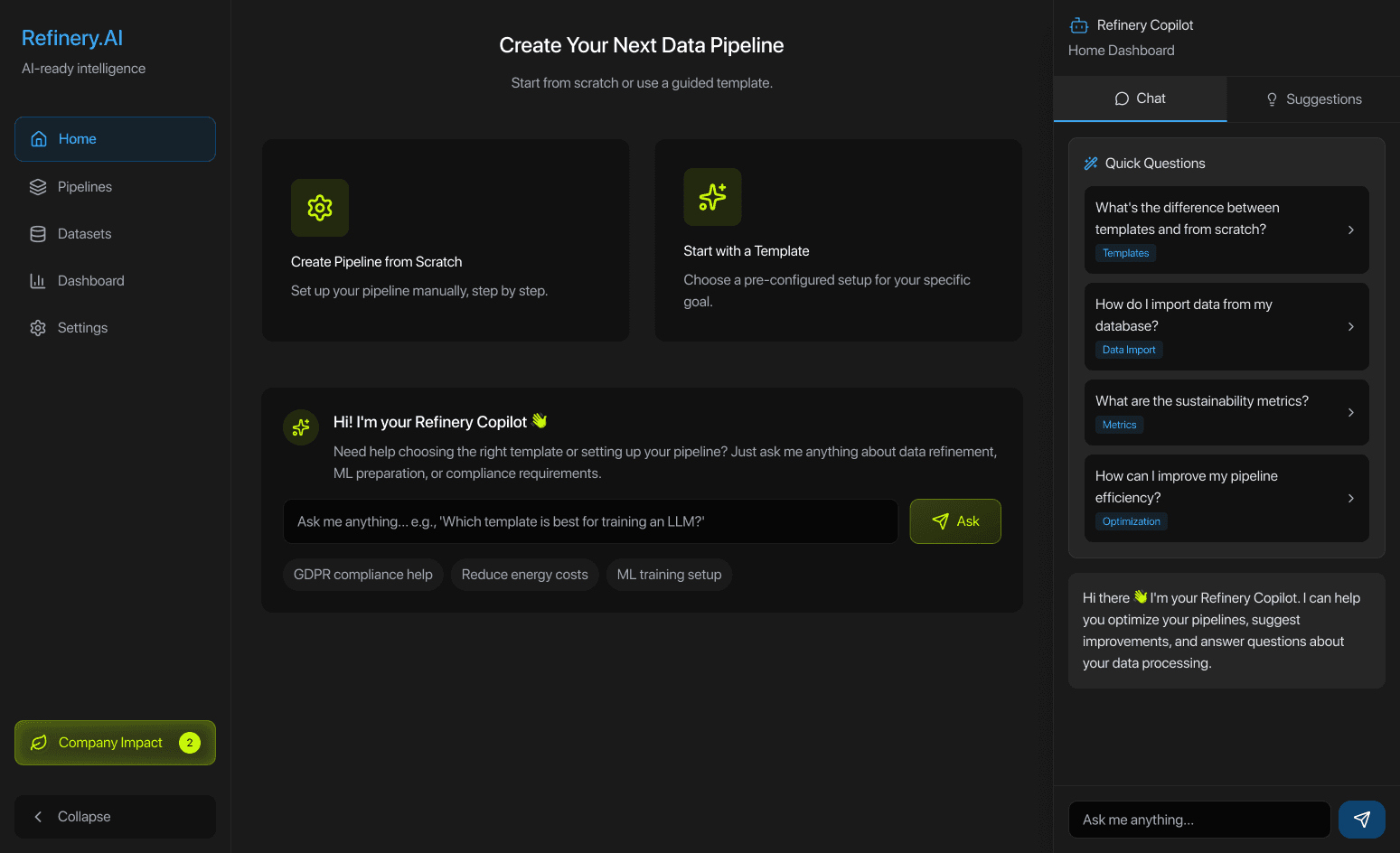


At the same time, flexibility remained a key requirement. For more advanced users, a visual pipeline builder was introduced, allowing them to configure and customize each step of the process. Inspired by node-based tools, this approach transforms complex workflows into modular, visual systems that are easier to understand and control.
To further reduce friction, an AI assistant was integrated across the entire platform. Rather than acting as a separate feature, it became a continuous layer of guidance, helping users make decisions, understand metrics, and optimize their pipelines in real time.
Refinery.AI simplifies data preparation by turning raw datasets into AI-ready pipelines through an intuitive, guided workflow. With templates, a visual builder, and built-in compliance and optimization, users can clean, enrich, and prepare data efficiently without deep technical knowledge.
The platform reduced time-to-market for AI projects, improved data quality and model performance, and lowered infrastructure and energy costs. It also enabled both technical and non-technical teams to work with data more effectively. And most important, reduce energy cost and save water for the planet.
Defining user intent before building pipelines is critical to delivering value. Guided experiences and AI assistance improve usability, while balancing flexibility with simplicity helps users navigate complex processes with confidence.