Supply Chain Platform for Logistics Operations
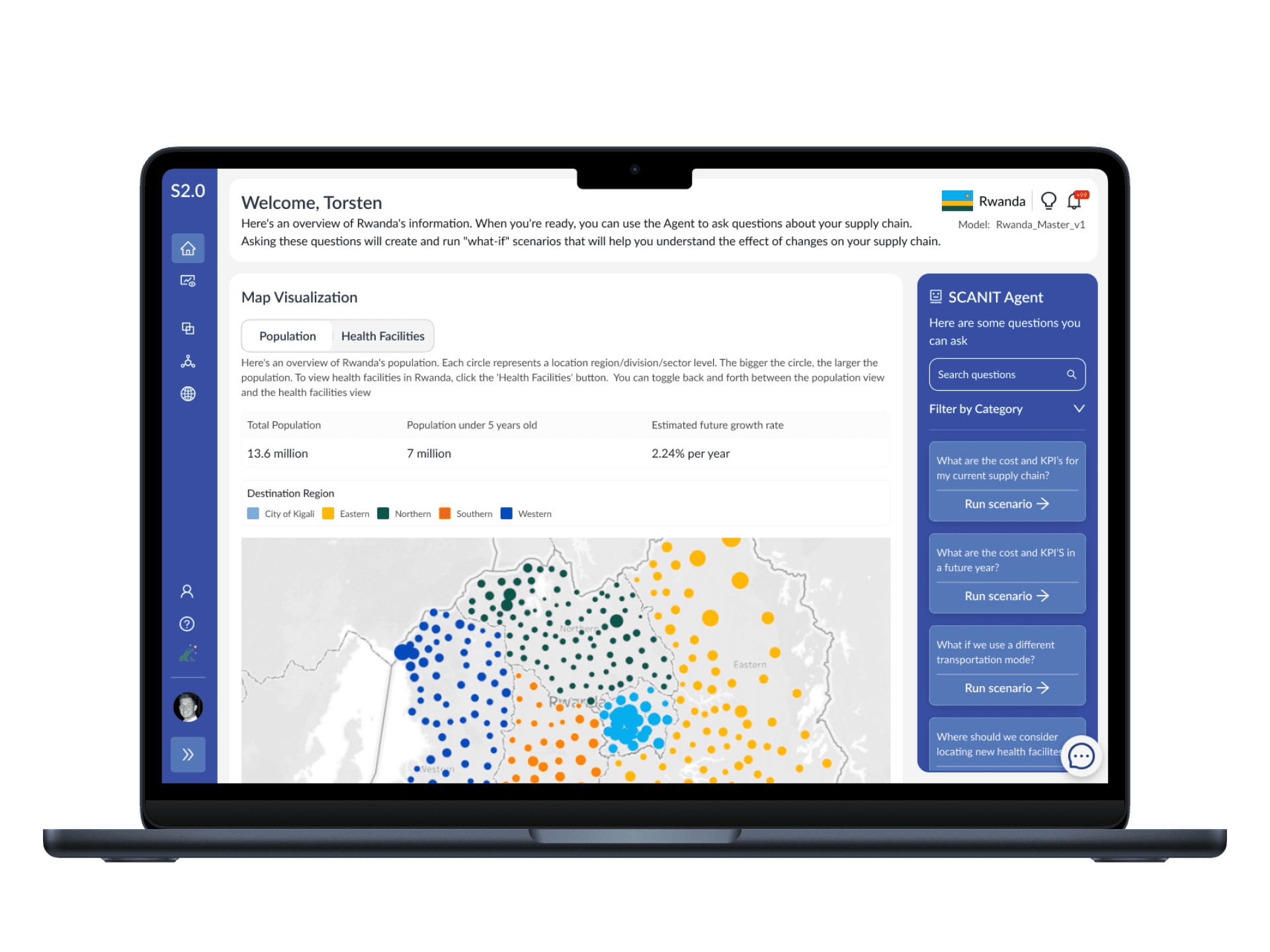
Project Overview
UX/UI design of a web platform for modeling and simulating supply chain networks. The tool allows users to analyze logistics scenarios, evaluate warehouse configurations, and optimize resource distribution through data visualization and simulation.
ROLE
UX/UI Designer
CLIENT
Global Humanitarian Organization
DURATION
6 months
RESPONSABILITIES
End-to-End UX/UI Design Procress
TEAM
PM, Developers, Tech Lead, UX/UI
Problem
Organizations managing humanitarian supply chains need to evaluate multiple logistics scenarios before making operational decisions. However, existing tools were complex, unintuitive, and required advanced technical knowledge.
This resulted in:
Difficulty configuring scenarios
Interfaces overloaded with information
Long and inefficient simulation processes
Limited accessibility for non-technical users
The challenge was to simplify the interaction with complex logistics data models.


Objectives
Simplify supply chain model creation
Enable intuitive configuration of logistics scenarios
Provide clear visualization through dashboards and maps
Improve data comprehension for decision-making
As a UX/UI Designer, I was responsible for:
Collaborating with the development team for implementation
Analyzing requirements alongside the Product Manager and Tech Lead
Defining information architecture
Designing user flows
Creating interfaces and dashboards
Developing high-fidelity prototypes in Figma
The design process began with a thorough analysis of product documentation and close collaboration with stakeholders to understand both business requirements and system constraints.
From there, I focused on defining a clear information architecture that could support the platform’s complexity. The system was structured into distinct modules —model creation, scenario configuration, simulation management, and results visualization— allowing users to navigate the product in a more predictable and controlled way.
This modular approach became the foundation for simplifying workflows and reducing cognitive load.

Designing this platform required a deep understanding of how supply chain systems operate. Users needed to model logistics networks by defining nodes such as warehouses and locations, configuring routes, and setting multiple operational parameters.
Mapping these interactions allowed me to identify where users experienced friction and where the system required better structure. This step was key to transforming a fragmented experience into a cohesive product.


One of the key priorities was to design flows that could guide users through complex tasks without overwhelming them.
The core experience was built around the process of creating and simulating a supply chain model. Users start by defining the structure of their network, configuring nodes and relationships, and setting operational parameters. From there, they can run simulations and analyze the results through structured outputs.
By breaking this journey into clear, sequential steps, the experience becomes more intuitive and easier to manage, even when dealing with large datasets and multiple variables.


Design Solution
The final solution was a modular and scalable interface that organizes complexity into manageable sections. Instead of exposing all variables at once, the design uses progressive disclosure to reveal information as needed, helping users stay focused and in control.

